













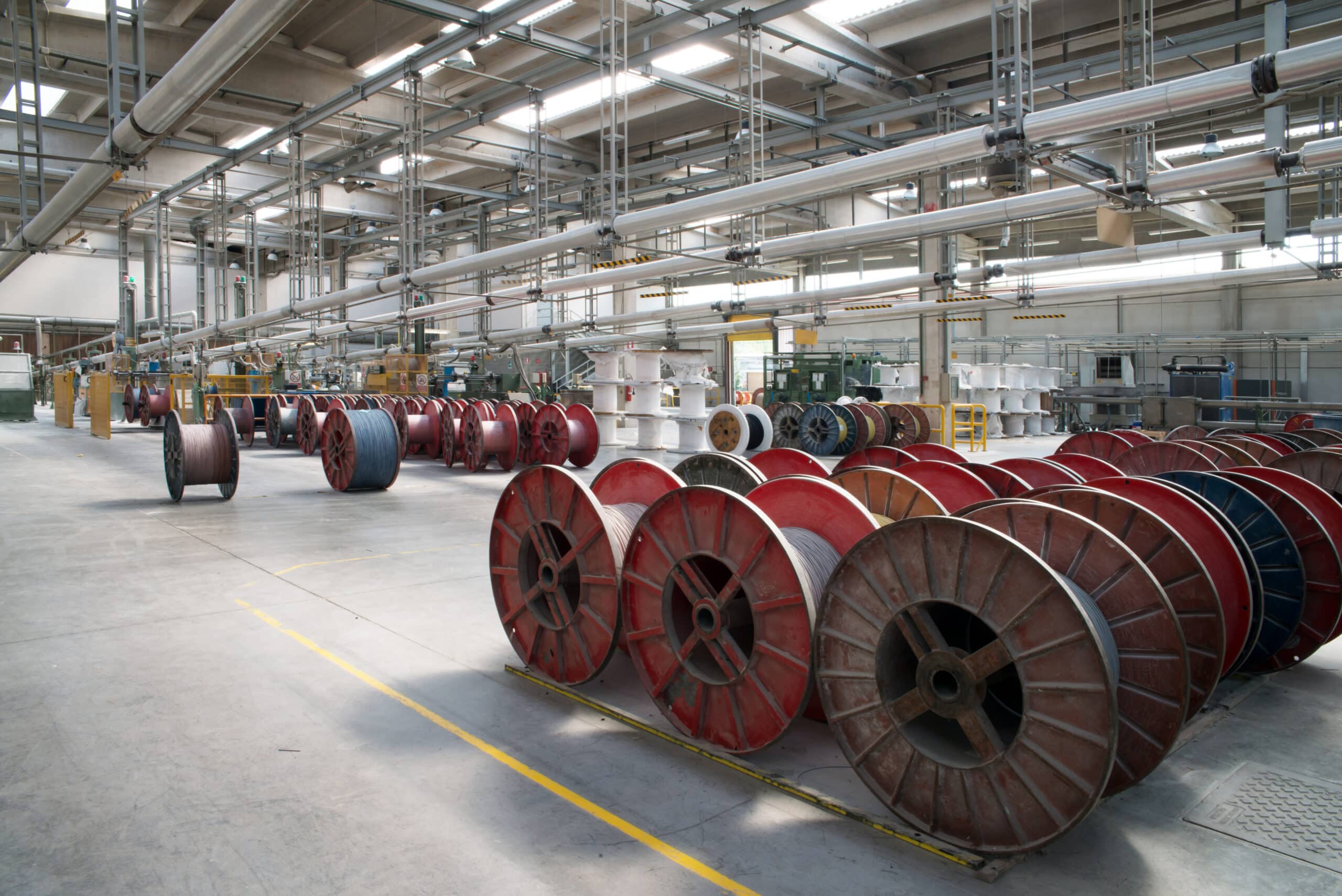
Cable manufacturers have historically relied on forklifts and overhead cranes to move reels through their facilities. It worked well when reels were manageable, a few hundred pounds, standard diameters, and had predictable dimensions. Workers knew the routine, equipment was sized for the job, and the plant floor ran smoothly – but that era is ending.
As demand for high-voltage power cable, EV charging infrastructure cable, and fiber optic cable has surged, the reels leaving production floors have grown dramatically in size and weight. What used to weigh a few hundred pounds now weighs several tons. What used to fit comfortably under a standard forklift’s capacity now exceeds it. Crane’s could once swing into place in a tight production bay, but that has become a hazardous, time-consuming operation that puts workers at risk.
Forklifts were not designed to cradle large-diameter round reels safely. A reel sitting on flat forks is unstable, and the heavier and wider the reel, the greater the risk of tipping and the potential for flange damage or cable surface contact. Cranes require rigging, certified operators, cleared floor space, and careful load calculations. Both solutions demand significant time and coordination for what should be a straightforward material movement task. Neither scales well as reel sizes continue to grow.
The cable manufacturers who are struggling with this problem right now are not alone, and it is not a problem that is going away. The forces driving reel growth are long-term and accelerating.
Why Reels Are Getting Bigger
Grid Modernization and Expansion
The United States electrical grid is aging, undersized for current demand, and being aggressively expanded. Global grid capital spending surpassed $470 billion for the first time in 2025, growing 16% year-over-year, driven by the urgent need to connect renewable energy sources, data centers, and electrified transportation to the grid. The International Energy Agency projects that global investment in power transmission will need to exceed $200 billion per year by the mid-2030s just to meet rising electricity demand.
More grid miles means more cable and more high-voltage and extra-high-voltage cable. These cables are physically large. They require thick insulation, larger conductor cross-sections, and longer continuous runs to minimize field splicing. All of that translates directly to larger drum diameters and significantly higher reel weights.
EV Infrastructure Buildout
The electrification of transportation is creating an enormous and sustained demand for high-capacity cable. DC fast chargers require thick, high-capacity power cable that is fundamentally different from the lighter-gauge wire used in residential and commercial applications. Nearly 300,000 electric vehicles were sold in the United States in the first quarter of 2025 alone, and the charging infrastructure required to support that fleet demands millions of miles of heavy cable. That cable needs to be manufactured. It comes on reels, and those reels are not small.
AI Data Centers and Power Demand
The explosion in artificial intelligence computing has created a parallel surge in power infrastructure demand. Data centers are expected to consume 35 gigawatts of electricity by 2030, up from 17 gigawatts in 2022, a growth rate of roughly 10% per year. Hyperscale data center developers in Virginia, Ohio, and Texas have become among the world’s largest single-site consumers of cable, with some pre-purchasing cable reels 12 months in advance to lock in allocations.
Each new facility requires massive amounts of medium- and high-voltage cable for power distribution. That cable is heavy and comes on large reels. And it has to move through a production facility before it ever reaches a data center.
The Wire and Cable Market at Large
These trends are not isolated. They are reshaping the entire wire and cable industry. The global wire and cable market reached approximately $245 billion in 2026 and is projected to reach $315 billion by 2031, with high-voltage power cables, fiber optic cable, and EV-related cables growing faster than the industry average. North American manufacturers are at the center of this growth, with the U.S. wire and cable market projected to grow at nearly 6% annually through 2030 as federal infrastructure investment drives sustained demand.
Volume is up. Specifications are more demanding. And the product coming off the production line is heavier.
What This Is Doing to the Plant Floor
Capacity and Safety Risk
Operating a forklift near or at capacity with an unstable round load is a safety risk that grows with heavy reels. The round flange profile of a cable reel sitting on flat forks creates a rolling and tipping hazard. Cranes eliminate some risks but introduce others: rigging errors, load swing, the need for cleared floor space, and the time to set up and execute each lift safely.
Throughput and Bottlenecks
Cranes and forklifts are shared resources between operators. When a crane or forklift is needed to move a reel, they aren’t available for anything else. Production is impacted due to the time needed for the move. As reels grow heavier and the complexity of each move increases, these shared resources become bottlenecks in the production schedule.
Floor Load and Staging
A heavy reel sitting on a plant floor exerts more point load on the concrete. Facilities built for lighter reels may face floor load capacity concerns as reel weights increase. Staging and storage layouts are affected when reels can’t be safely stacked, taking up more floor space and creating congestion in production and shipping areas.
Equipment Mismatch
Equipment that works for the lighter reels may not be safe or practical for the heavier ones. This forces facilities to either limit what equipment handles which size of reel, use general-purpose equipment in ways it was not designed for, or invest in multiple handling solutions. These solutions cause many problems for the cable manufacturers.
What Modern Cable Facilities Need
Manufacturers navigating this shift successfully share a common set of requirements for their reel-handling equipment.
- Ground-level pickup. Purpose-built reel transporters lift directly from the floor without requiring the reel to be pre-positioned on a stand or rigged for a crane. This eliminates the setup time and coordination overhead that crane-based handling requires.
- Single-operator capability. Labor costs are rising and skilled workers are in short supply. Equipment that allows one operator to safely move a multi-ton reel without assistance is a necessity for maintaining throughput without expanding headcount.
- Adjustability across reel sizes. Facilities handling multiple cable types need handling equipment that adapts to different reel diameters without requiring a separate machine for each specification.
- Battery power. Indoor production environments cannot accommodate the emissions of propane or diesel equipment. Battery-powered transporters operate cleanly and quietly without ventilation concerns, and they can run full shifts without the fuel management overhead of combustion equipment.
- Automation compatibility. As cable production volumes grow and labor availability remains constrained, the ability to integrate reel handling into an automated guided vehicle (AGV) system becomes increasingly valuable. Equipment that can scale from manual operation to full automation protects the capital investment and gives facilities a path forward as their needs evolve.
- Cable and flange protection. Purpose-built cradle systems hold the reel by its flanges without contacting the cable surface, eliminating the damage risk that comes with improper forklift contact and protecting what is often a very high-value load.
Solutions Built for This Problem
Align Production Systems designs and manufactures reel-handling equipment specifically for the wire and cable industry, built to meet these requirements.
Fixed Cradle Reel Transporters are engineered for facilities running consistent reel sizes. The cradle is built to the specific drum diameter and capacity requirements of the customer’s production, with hydraulic arms that lift the reel directly from the ground. A single operator has full, positive control of the load throughout the move. These units are battery-powered, built for indoor use, and can be specified to handle reel weights that far exceed forklift capacity.
Adjustable Cradle Reel Transporters are designed for facilities managing a range of reel diameters and widths. The adjustable arms accommodate a wide range of reel sizes, eliminating the need for multiple pieces of equipment across a mixed production line. Like the fixed cradle units, these are battery-powered and AGV-compatible for facilities looking toward automation.
Custom Carts and Power Tuggers offer a scalable, lower-cost system for facilities moving reels across longer floor distances. Carts are designed and built to customer specifications and load requirements, and battery-powered tuggers handle the movement. The system is expandable, adding carts and tuggers as production volume grows without replacing the entire handling infrastructure.
AGV-Integrated Systems are available for manufacturers ready to automate reel movement entirely. Align’s AGV systems are custom-designed for cable reel handling, built to accommodate the weight distribution and dimensional characteristics of large reels, and can be configured with LiDAR, optical line following, or magnetic navigation to fit existing plant layouts. These systems operate continuously with minimal human interaction, freeing operators for higher-value work and creating a more predictable, scalable production environment.
Align’s engineering team works directly with cable manufacturers to develop solutions for your reel sizes and environment. With over 50 years of experience in heavy industry material handling, Align brings both the product capability and the application knowledge to solve problems that general-purpose equipment simply cannot address.
The Reels Are Getting Bigger. Is Your Plant Ready?
The infrastructure buildout driving cable demand is not a short-term phenomenon. Grid modernization, EV charging expansion, data center construction, and fiber network buildout are decade-long capital commitments that are accelerating, not slowing. The cable manufacturers who position themselves to produce efficiently at higher volumes and heavier specifications will be better placed to capture that demand. The ones who continue moving increasingly heavy reels with equipment designed for a smaller, lighter product will face growing costs, growing safety exposure, and growing constraints on throughput.
The question is not whether the reels will keep getting bigger. They will. The question is whether your plant floor is equipped to handle them.
Align Production Systems will be exhibiting at Wire Expo. Visit booth 613 to see our cable reel handling solutions in person and speak with our engineering team about your specific reel sizes and handling challenges.


