













Moving Pallets Made Simple: How a Low-Profile Transporter Keeps Production Flowing
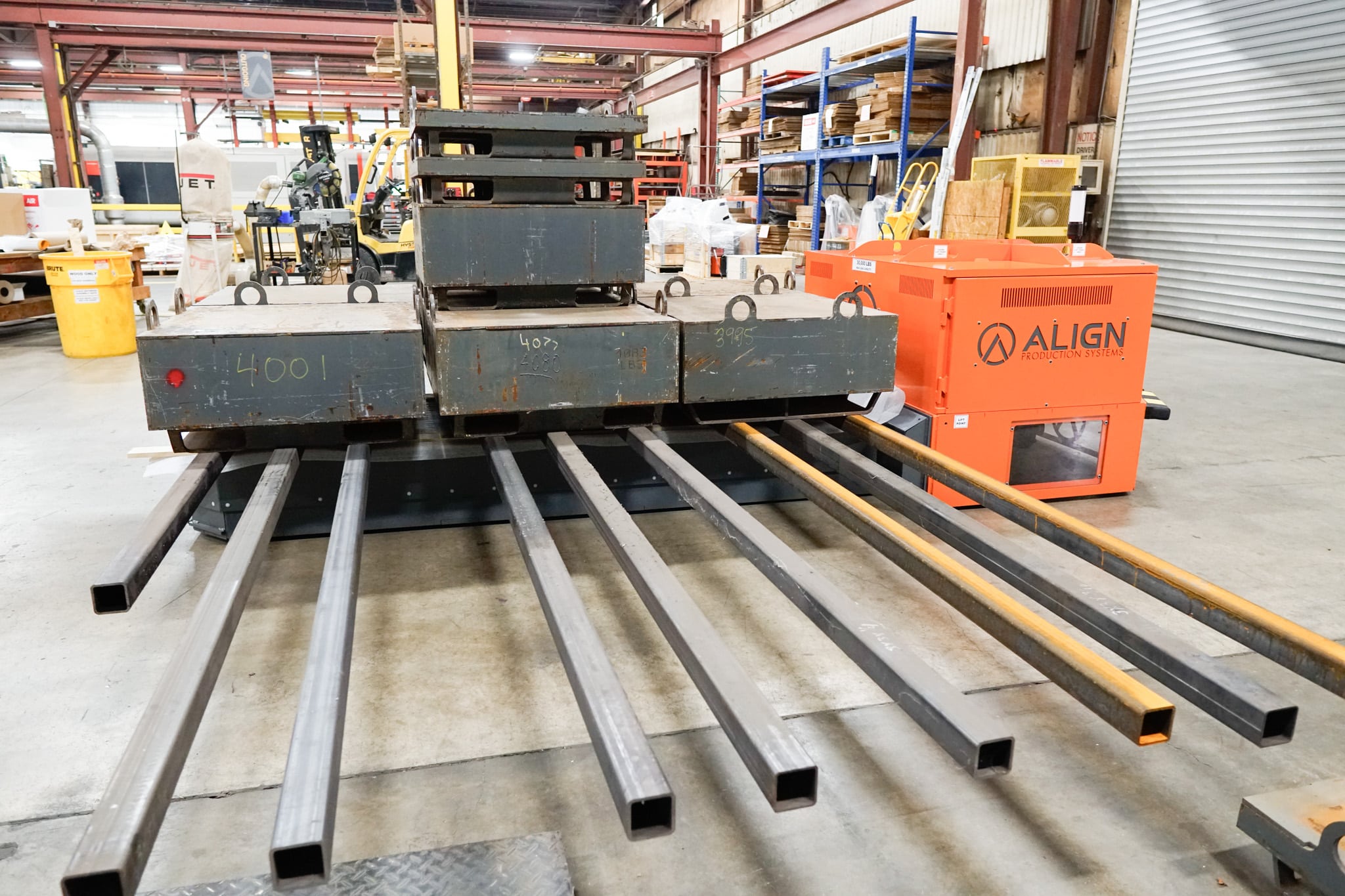
When your entire operation depends on getting pallets from Point A to Point B, “good enough” material handling isn’t good enough. Forklifts and pallet jacks can be bulky, hard to maneuver in tight spaces, and inconsistent from operator to operator. This custom pallet transporter was engineered to give one person precise, repeatable control over heavy pallet movement.
Built Around the Pallet, Not the Other Way Around
Instead of forcing the customer to redesign their pallets around standard equipment, we can build a custom platform or pallet transporter to match the exact pallet footprint and opening. The unit drives directly under pallets resting on the floor, lifts them, and carries them to the next station.
Key design points from our most recent project:
- Low-profile frame slides into a very specific gap beneath the pallet.
- The 3 inches of lift give just enough height to clear the floor and travel safely.
- 30,000 lb capacity handles substantial loads while staying compact.
By designing to the pallet’s dimensions and load distribution, the transporter delivers the tractive force and lift performance needed—without excess size or complexity.
Pallet Transporter vs. Platform Transporter
When we talk about moving pallets, you’ll often hear two terms: pallet transporter and platform transporter. They’re closely related—and in many cases share the same drive, lift, and control concepts—but they interact with the pallet in different ways.
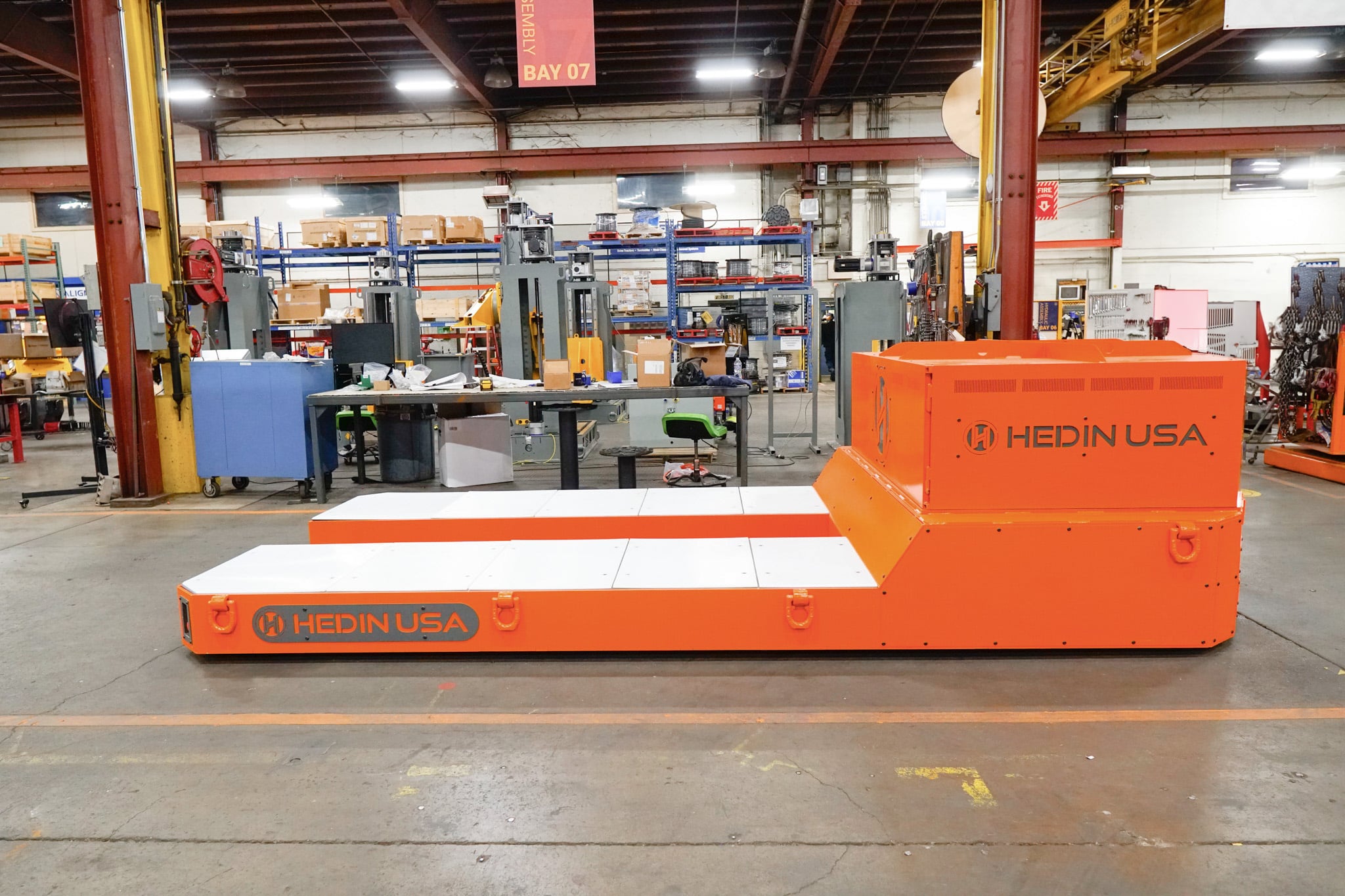
Pallet Transporter (Fork-Style)
Uses two forks that slide into standard fork pockets or openings in the pallet.
Works best when the pallet is wide enough and has two fork slots spaced apart.
Ideal for more conventional pallet designs where fork access from the front or side is built in.
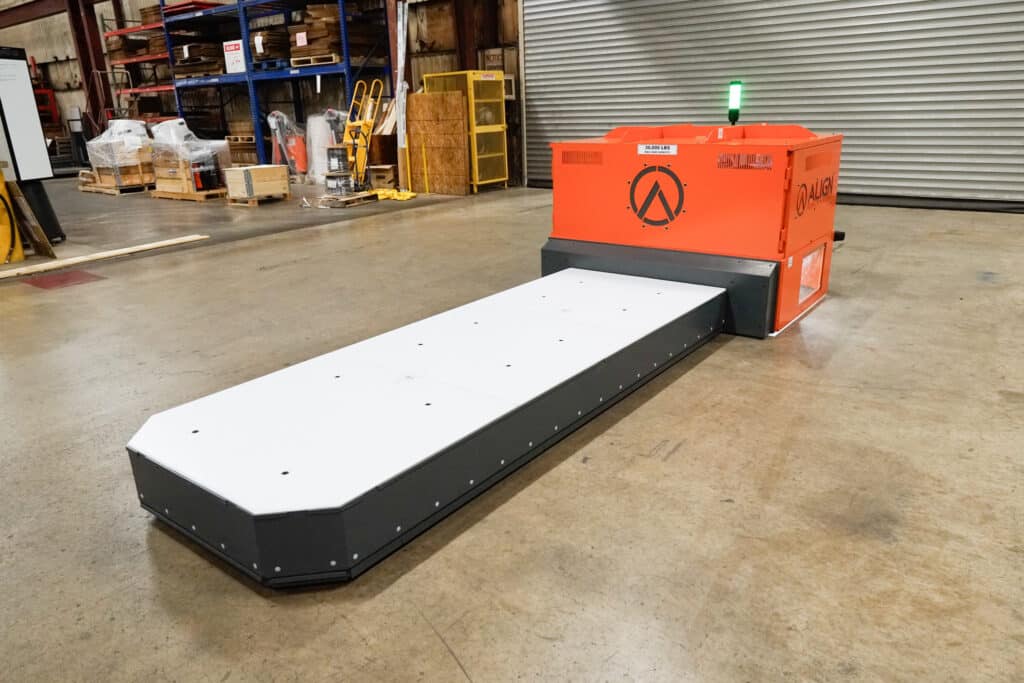
Platform Transporter (Deck-Style)
Uses a solid platform or deck instead of forks.
Designed to slide into a single, relatively narrow opening or under a pallet with a central slot where forks won’t fit well.
Especially useful when the pallet shape, cutouts, or load support make a full-width platform a better choice than split forks.
In both cases, you’re still getting a pallet transporter—the difference is whether we support the load with forks or with a platform. The decision usually comes down to pallet geometry:
- If it’s wide with two clear fork pockets, fork-style makes sense.
- If it’s more narrow or has a single central opening, a platform-style design is often the better fit.
That flexibility allows us to tailor the transporter to your pallets, rather than forcing you to redesign your pallets to fit the equipment.
Flexible Navigation: Single-Drive or Omni-Directional
This style of transporter can be engineered with either a single drive header or a multi-drive system, depending on the customer’s needs for moving pallets through their process.
With a single drive header, the transporter behaves more like a traditional vehicle:
- One powered drive unit provides the pulling force and steering.
- Idler wheel sets act as the pivot point, letting the unit rotate tightly around the load.
- Operators use the remote to drive forward, backward, and turn in place to line up with pallets in tighter areas.
This is a great fit when operators want intuitive, “car-like” control without adding complexity.
For applications that demand more advanced positioning, a multi-drive configuration can be used to create an omni-directional transporter:
- Multiple powered wheel modules work together to move the platform in any direction.
- The transporter can travel forward, backward, sideways, and rotate on its centerline.
- This makes it easier to thread pallets through congested aisles, tight production cells, or around existing equipment without constant backing and re-approaching.
Both options’ goal is to provide a single operator with precise, confident control over heavy pallet movement.
Path to Automation: Turning Transporters into AGVs
The same pallet and platform transporters we build for manual operation can be engineered as AGVs (automated guided vehicles) or designed to be automation-ready from day one.
Because the core structure is already in place—drive units, steering, lift system, and battery power—we can add an automation layer on top of the existing platform:
- Navigation & control: Integrate AGV controls for fixed-path guidance, laser guidance, or natural feature navigation so the transporter can run pre-programmed routes between stations.
- Safety systems: Add AGV-grade safety scanners, area sensors, and warning devices to monitor surroundings and slow or stop when people or obstacles are detected.
- Fleet and traffic management: Connect multiple transporters to a central system that manages traffic, priorities, and missions across the plant.
- Automation-ready design: Even if you start with a manually operated unit, we can design the frame, wiring, and control layout so it’s ready for a future upgrade to full AGV operation.
This approach lets you start with a practical, operator-controlled pallet transporter today and grow into automated pallet movement when your process, staffing, or throughput requirements call for it.
Designed for Low Maintenance and Fast Service
When you’re moving pallets all day, downtime hurts. This transporter was designed to make it easy to access and replace parts.
Service-friendly features include:
- Modular construction – Header unit, base, top, and front are all bolted together so major sections can be removed without cutting or reworking the frame.
- Lift deck that can be craned off for deeper access when needed.
- Idler wheel sets that unbolt for quick wheel replacement.
- Auto greasers and grease canisters to keep the steering bearing lubricated without daily manual attention.
Routine maintenance for the operator or maintenance team is simple:
- Check that grease canisters are filled.
- Inspect the hydraulic system for leaks and clean fluid.
- Confirm wheels are in good condition.
If anything does need to be repaired, the modular layout and access doors mean technicians aren’t fighting the machine just to reach basic components.
Safety and Operator Confidence
Safety is built into every transporter we design, whether it’s a simple, operator-driven platform or a more advanced multi-drive system. Typical safety features include:
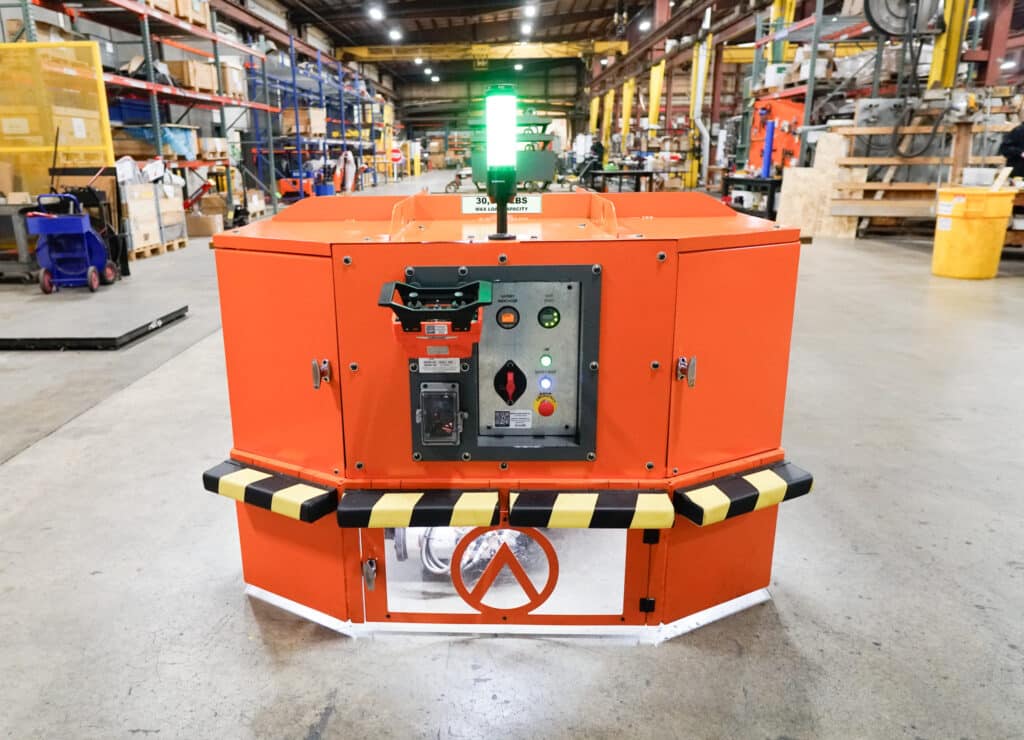
- Emergency stop buttons to immediately cut power in the event of an issue.
- Stack light indicators so operators and nearby personnel can quickly see status or error conditions.
- The Safety Horn on the controllergives operators an easy way to alert nearby personnel before moving or when maneuvering in tight areas.
Because every facility and process is different, we can customize the safety package for each transporter—adding or adjusting features to match your internal standards, operating environment, and risk assessments—so operators feel confident moving heavy pallets day after day.
Turning One Operator into a Pallet-Moving Crew
At its core, this pallet transporter gives one person the ability to move heavy pallets quickly and confidently, without relying on forklifts or multiple team members. It handles the heavy lifting, tight navigation, and long travel distances, while staying simple to operate and maintain.


