













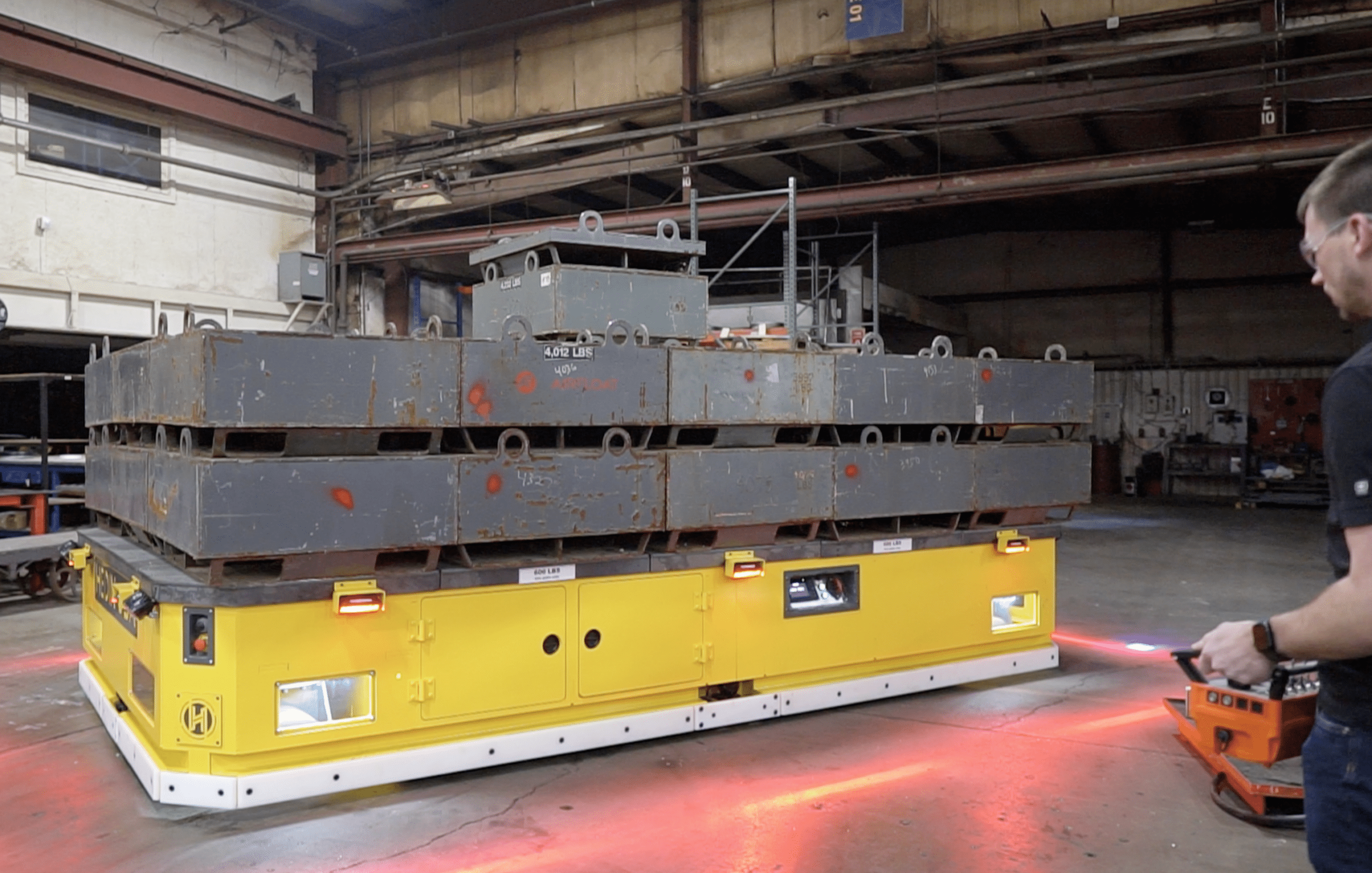
There’s a lot to consider when selecting a transporter, but the customer question we get the most is how the unit actually moves. That question sounds technical, but it’s really about something very practical: how the unit gets from point A to point B on your floor. This article breaks down what single-drive or single-steering and multi-drive (referred to as all-wheel steering, omnidirectional movement, and crab walking) actually mean, how the two systems differ mechanically, and how to think about which one fits your application.
What Single Drive Steering Means
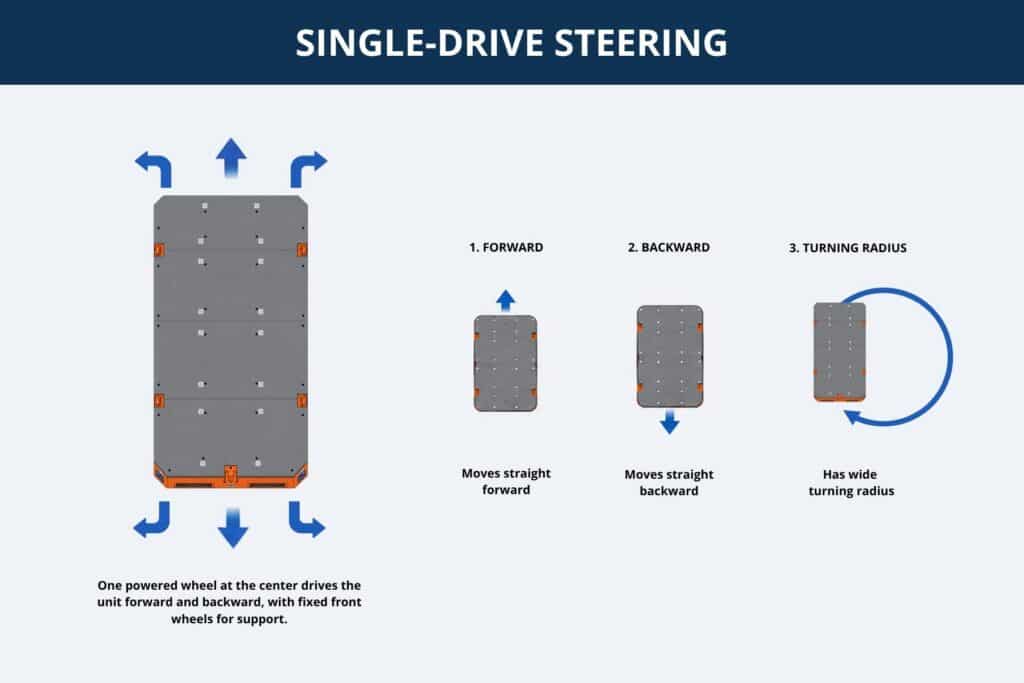
A single drive unit has one powered drive system moving the entire vehicle. That drive is placed at one location, usually the front or the rear of the unit, and is responsible for propelling and steering the entire load. Because there is only one drive point, a single drive unit turns by tracing an arc rather than pivoting in place.
The easiest way to picture this is to think about how a pallet jack moves. A pallet jack has one steering and drive point at the front, with fixed wheels trailing behind it. A single drive transporter works on the same principle, which is why our team often describes it to customers as driving like a pallet jack. It can move forward and backward and it can turn, but that turn follows a curved path rather than a tight rotation.
Single drive systems are generally more cost effective, which makes them a good fit for many applications. The tradeoff is that they require a consistent load center of gravity and wider turning area than multi-drive.
What Multi-Drive Steering Means
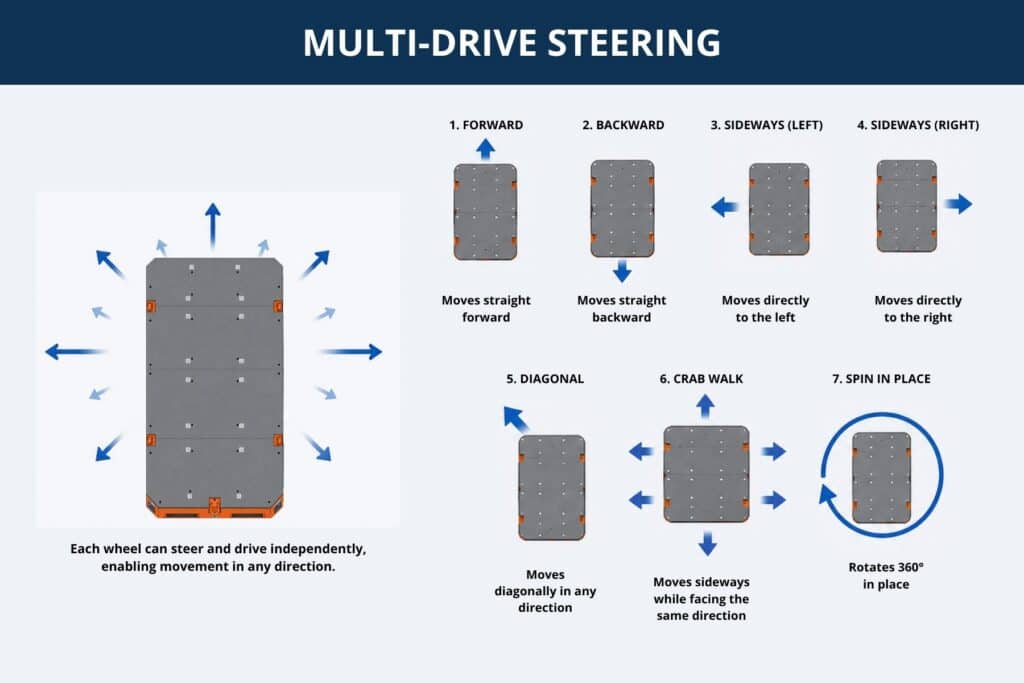
A multi-drive unit has more than one powered drive system working together. Since the drives are positioned independently, the unit is not limited to an arced turning path and has a zero turn radius.
Multi-drive, all-wheel steering, omnidirectional movement, quad steer, and crab walking all describe the same underlying capability. There are multiple drives working together, and the transporter itself can rotate a full 360 degrees or move diagonally without changing the direction it’s facing.
Multi-drive systems cost more than single drive systems, but that added cost buys real functionality. Because more drive units are in contact with the ground, multi-drive transporters generally handle poor traction conditions better, and they carry heavier loads than a single drive unit.
How Each System Moves
It helps to think about the movement paths each system is actually capable of.
A single drive unit can move forward and backward and can turn. Every turn follows a curved arc, similar to steering a pallet jack or driving a forklift.
A multi-drive unit can do everything a single-drive unit does, plus move side to side, move diagonally, and rotate in place around its own center point. Rotating about center instead of arcing through a turn is the single biggest functional difference between the two systems.
How to Decide Between the Two
A lot of customers start out assuming they want a single drive unit. By the time they walk through the details of their application, many end up choosing a multi-drive system instead, because they determine they want to minimize the space required to maneuver the unit into their desired positions.
If your application involves traveling a mostly straight path, such as moving loads down a long aisle, then a single drive unit is a good fit. If your application involves tight spaces, precise positioning, or aisles where there is not enough room to complete a wide turn, then a multi-drive unit is what you will want.
When to use Single Drive:
- Your facility has wide aisles with room to complete a normal turn
- Cost is a primary factor and the application doesn’t require tight maneuverability
- Loads have a consistent center of gravity and are consistently placed in the intended position on the transporter
When to use Multi-Drive:
- Aisles or pathways are tight and there isn’t room to complete a traditional turn
- Loads need to be staged in a line, such as in a data center or tight production cell
- Consistent performance on flooring, since having multiple drive points reduces reliance on any single wheel for traction
- Large, oblong, or heavy loads cause a single drive to carry too much of the load’s weight, making balance harder to maintain
- The application calls for side shifting, diagonal movement, or rotating in place
So Which One Do You Need?
Single drive and multi-drive are really shorthand for two different approaches to movement. Single drive keeps things simple and cost effective for applications where a vehicle-style turn gets the job done. Multi-drive adds the ability to rotate in place, shift sideways, and move diagonally, which matters most in tight or precisely arranged spaces. Understanding which one your facility actually needs comes down to thinking less about the load itself and more about the path that load has to travel to get where it’s going.
If you are not sure which setup fits your application, our team can walk through your layout and load requirements with you and help you find the right solution.


