













What to Consider When Selecting Material Handling Equipment for Heavy Industrial Applications
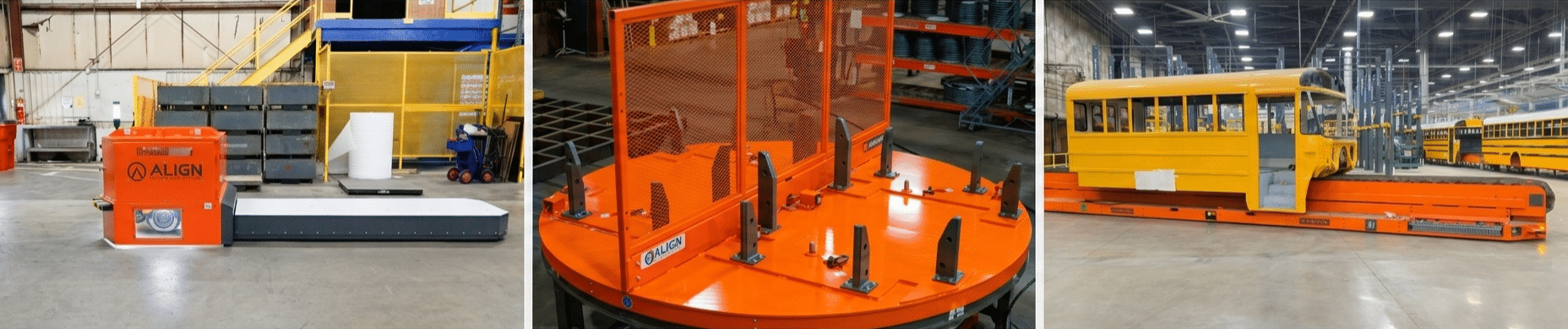
Moving a 500-pound pallet and moving a 50,000-pound steel assembly are both “material handling” problems, but they have almost nothing in common. The equipment, the planning, the floor requirements, and the safety considerations are different for high capacity loads.
What Equipment is Right For Me?
Here’s what actually matters when you’re selecting material handling equipment for heavy industry applications.
1. Know Your Load
Load capacity is the most obvious starting point, but most buyers only think about the weight of the product itself. In heavy industry, that’s not enough.
You need to account for:
- The product weight: the actual part, assembly, or raw material being moved
- Fixture and tooling weight: jigs, pallets, cradles, and carriers added to the load
- Dynamic load factors: weight distribution shifts during movement, tilting, or rotation
- Future load growth: will your parts get heavier as your product line evolves?
Under sizing equipment for a warehouse environment is an inconvenience. Under sizing it for a 160,000-pound electrical transformer or a large agricultural equipment assembly is a safety incident waiting to happen. A common industry rule of thumb is to select equipment rated for at least 25% more than your anticipated peak load.
2. Understand What the Load Needs to Do
Movement is rarely just point A to point B. Before you select any piece of equipment, map out exactly what the load needs to do throughout your process:
- Does it need to travel across the floor, or stay in one place?
- Does it need to rotate so operators can access all sides without repositioning?
- Does it need to be tilted or upended to change orientation for assembly or inspection?
- Does it need to be lifted vertically, or only moved horizontally?
- Does it need to index through multiple workstations on a line?
Each of these motion requirements points to a different category of equipment. A load that needs to rotate in place calls for an industrial turntable. A load that needs to travel long distances across a facility floor calls for a flatbed transporter or AGV. A load that needs to go from horizontal to vertical calls for a hydraulic upender. Getting the motion requirement right before you start evaluating products saves significant time and budget downstream.
3. Assess Your Floor
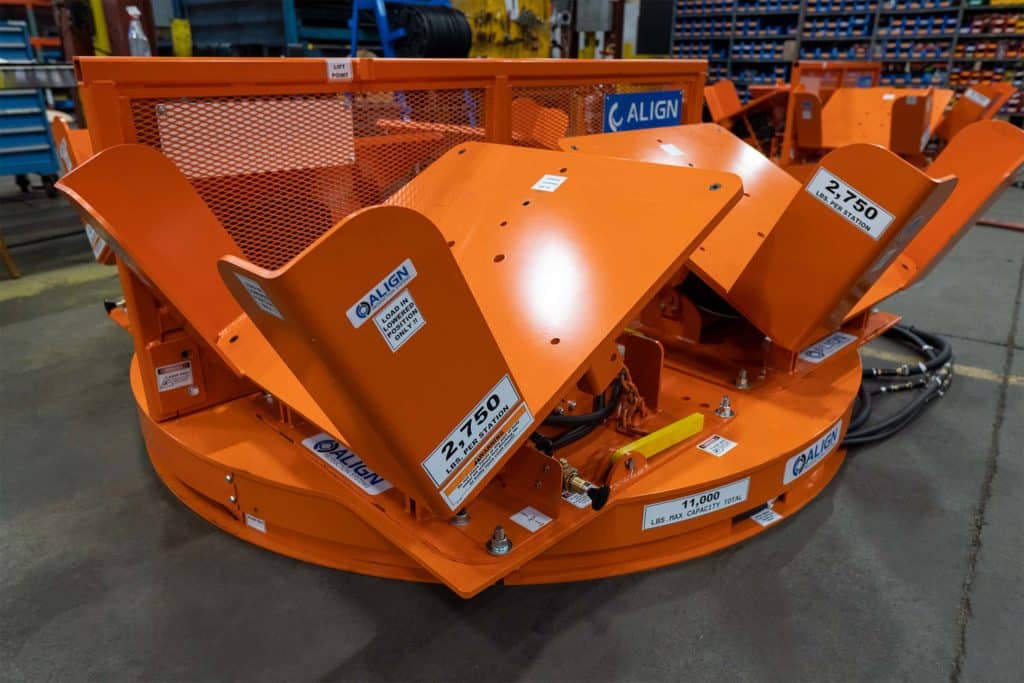
This is the consideration that gets skipped most often, and it’s one of the most consequential in heavy industrial environments.
Your facility floor is not a neutral variable. At heavy load weights, the condition and specifications of your floor directly determine what equipment can operate safely and effectively. Key factors include:
- Floor Flatness and Levelness: variations affect how equipment tracks, how smoothly AGVs navigate, and whether loads shift during transport
- Load-Bearing Capacity: your floor slab needs to handle the combined weight of product and equipment, concentrated through wheels or casters
- Surface Condition: cracks, joints, surface coatings, and contaminants all affect traction, equipment longevity, and safety
- Slope and Drainage: even minor grades invisible to the eye can cause issues for transporters and AGV navigation
Discovering that your floor can’t support your new transporter after it arrives is an expensive problem. Discovering it beforehand lets you address it as part of the project plan.
4. Match the Equipment to Your Workflow
Heavy industrial facilities aren’t static. Materials move through receiving, staging, assembly, quality inspection, and shipping often through multiple departments with different floor layouts, aisle widths, and clearance constraints.
The right equipment fits your workflow as a system, not just the heaviest single move in your operation. Consider:
- Route complexity: is the path straight, or does it require turning in tight spaces?
- Frequency: is this a continuous production move or an occasional heavy lift?
- Operator involvement: do you need a one-person solution, or is a crew available?
- Integration with other equipment: does the transporter need to interface with a turntable, conveyor, or fixed workstation?
A power tugger is an excellent fit for facilities that need to move heavy loads on carts flexibly across a floor with a single operator, where routes change, or loads vary. A flatbed transporter is better suited for defined, heavier-duty routes. An AGV system makes the most sense when movement is repetitive, predictable, and high-volume enough to justify automation. None of these is universally “best.” The right answer is the one that fits how your facility operates.
5. Think About Operator Safety
In heavy industry, material handling incidents aren’t minor. A load failure, tip-over, or collision involving equipment moving tens of thousands of pounds has serious consequences for people and equipment.
When evaluating any piece of heavy material handling equipment, examine the safety architecture closely:
- Anti-Tip and Stability Features: how is the load secured during movement?
- Operator Protection: for walk-behind equipment like power tuggers, is there an auto-reverse belly-button safety switch to prevent the operator from being pinned?
- Visibility and Alerts: does the equipment have audible alarms, light bars, or other collision-avoidance aids?
- Emergency Stop Capability: how quickly and reliably can the equipment be brought to a stop?
For AGV systems, safety is even more important, including navigation reliability, obstacle detection, zone control, and fail-safe behaviors when the system encounters an unexpected condition. Safety features aren’t a premium add-on. In heavy industry, they’re baseline requirements.
6. Factor in Total Cost of Ownership
The sticker price of a piece of heavy material handling equipment is rarely the most important number. What matters more is what the equipment costs to own and operate over its useful life.
Total cost of ownership for heavy material handling equipment typically includes:
- Initial purchase price
- Installation and commissioning costs
- Energy consumption: battery-powered equipment offers significant operating cost advantages, with no emissions and the ability to charge from standard 110V outlets
- Scheduled maintenance: how often does the equipment need service, and what are the labor and parts costs?
- Unplanned downtime: how reliable is the equipment, and what’s the cost to your production line when it’s out of service?
- Parts availability: are replacement parts readily available, or do long lead times mean extended downtime?
- Operator training: how much training does safe, effective operation require?
Battery-powered transporters and tuggers have gained significant ground in heavy industry because of their lower energy costs, no fuel handling, reduced maintenance compared to combustion equipment, and no emissions in enclosed facilities.
7. Know When Standard Equipment Ends and Custom Engineering Begins
Not every heavy industrial application fits a standard product. Unusual load geometries, extreme weight requirements, limited floor space, or very specific integration needs can require a custom solution.
Signs you may need custom-engineered equipment:
- Your load weight or dimensions fall outside standard product specifications
- Your facility layout requires a non-standard equipment footprint or turning radius
- Your process requires motion combinations not available in standard configurations
- Your product requires specialized fixturing or interface points built into the equipment
At Align, our engineering team can work with you to design a solution for your application.
8. Evaluate the Supplier, Not Just the Equipment
In heavy industry, the relationship with your equipment supplier matters well beyond the sale. You’re not buying a piece of equipment, but investing in a solution that your production operation will depend on, potentially for decades.
Key supplier questions to ask:
- Do they have experience with applications at your load scale and in your industry?
- Can they provide references from facilities with similar requirements?
- What does their post-sale support look like — and what’s their typical response time when something goes wrong?
- Do they offer spare parts availability, and how quickly can critical components be sourced?
- Can they support future modifications or expansions as your production needs evolve?
A supplier with deep application experience in heavy industry will ask different questions than a general equipment dealer. They’ll want to understand your process, your floor, your workflow, and your growth plans to recommend the best equipment for your application.
The Right Equipment for Your Application
Align Production Systems designs and manufactures material handling equipment built specifically for the demands of heavy industry, from industrial turntables and flatbed transporters to power tuggers, AGV systems, hydraulic upenders, welding positioners, and coil handling equipment.
With over 50 years of experience and in-house engineering and fabrication capabilities, we work with operations teams to identify the right solution for each application to recommend a standard product, a customized configuration, or a fully engineered system.
If you’re evaluating equipment for a heavy industrial application, contact our team to discuss your requirements at sales@alignprod.com.


